
A Lowcountry Love Story
See More
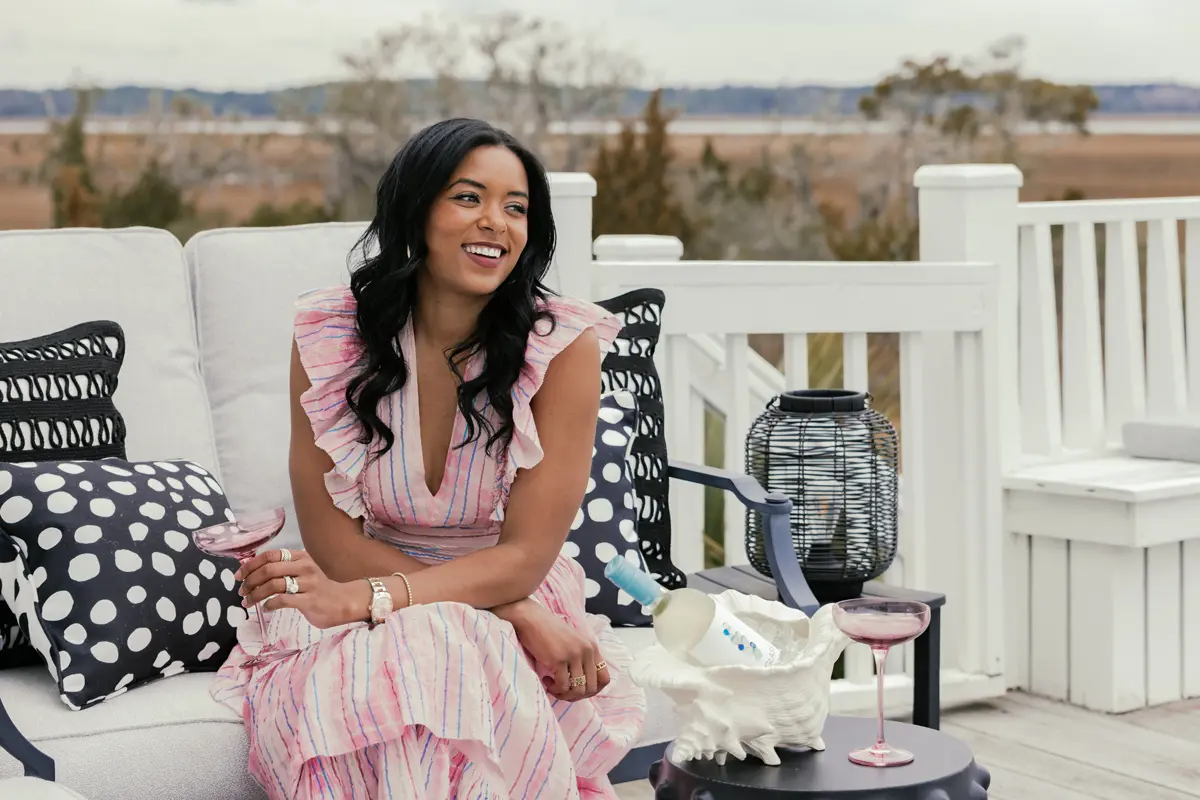
Megan Pinckney Rutherford felt the pull of James Island and created a second home built for the next generation
If you were born and raised in South Carolina, tradition is part of your DNA. You inherently understand what time Sunday dinner is served, you know–and agree with–your family’s recipe for deviled eggs, barbeque, and cornbread. Likely, your children cheered for the correct college football team before they knew the alphabet.
But why do the traditions matter? Where did they come from and why were they kept?
These are just some of the questions that have shaped the life of Megan Pinckney Rutherford, a woman often recognized for her content handle @shadesofpinck.
She’s a sixth-generation Charlestonian, so her roots run deep in South Carolina’s oldest city. But her journey to understanding the impact of tradition didn’t start until she moved to Columbia, married Todd Rutherford, a member of the South Carolina House of Representatives, and became a mother.
“We just did what we did because everybody else around us did it as well,” she says. “I never really got an understanding for why. For example, why are collard greens a staple on Sunday dinner? The more I understood why, the more beautiful it started to look to me. It stopped being so mundane and so average, and it started to be really, really special and something that I wanted to pass down.”
To make sure her four-year-old son, Teagan, felt connected to the family’s history in Charleston, Pinckney Rutherford started dreaming of a second home, one specifically with a marsh view. Her grandmother told her about a house on James Island and even gave her a video tour on her phone. Pinckney Rutherford wasn’t so sure, but as is only appropriate in a story infused with tradition, her grandma knew better. “She hung up the phone and called my husband,” Pinckney Rutherford laughs, “and told him, ‘Megan said no, but I’m telling you, you need this house.’”
Nestled among oak trees and Spanish moss, James Island, where Pinckney Rutherford grew up, is a small residential town just outside of Charleston. Her grandfather’s great-great grandfather purchased land on James Island on December 24, 1884, during the Reconstruction Era. And though many of her family still live on this property today, it lacked something significant: access to water. “We did not have a view,” says Pinckney Rutherford, “and that was very intentional. Back then, they were never going to let a formerly enslaved man buy beautiful land with a view.”
The house that Pinckney Rutherford and her husband bought offered similar history. Both properties were once part of Dill Plantation, the very land where her ancestors were enslaved before the Civil War. “It really does feel like this is ordained,” she says. “This land that once oppressed and enslaved my family became a piece of their emancipation, and a piece of their independence.”
But that is where the similarities stopped because this house has majestic views. The marsh feels expansive out the back steps and windows frame it like art at every turn. It’s a place that both inspires Pinckney Rutherford and offers a source of quietude for the young mom. She is grateful for the view, yes, but also for the opportunity to write her own chapter.
The divinity of the situation inspired her to dig deeper into her ancestral history. She began learning more about the Gullah Geechee culture, a heritage of enslaved Africans who lived in the Lowcountry of South Carolina and coastal Georgia. Due to the geographic isolation, the Gullah Geechee maintained much of their traditions such as sweetgrass basket weaving, cooking and canning, narrative and vernacular.
But their story began well before enslavement. In 2023, Pinckney Rutherford traveled across an ocean, to the Republic of Ghana in West Africa, to learn more about the history that shaped her family’s traditions and felt an immediate connection with the country. “It just felt like home,” she says. “I realized that this is our foundation. What we do really comes from this, not from slavery.”
In Ghana, Pinckney Rutherford purchased a piece of art that she would proudly hang in her son’s playroom at their second home. She used West African art throughout the rooms as a main motif to honor her lineage. Pinckney Rutherford selected black art and imagery and added sweetgrass baskets and flowers to nooks and tables. The mixture of history and tradition with moments of designer wallpaper and breathtaking views is all intentional.
“In Columbia, we are always on the move, just by nature of my husband’s career and where we live smack dab in the middle of downtown,” she says. “But when I get to Charleston, it is a much slower pace, and it’s very intentional. It’s not abnormal for me to get here and not leave the house. I spend a lot of time reading, writing, peering out the window and being in the kitchen.”
The Rutherfords renovated the kitchen to be the focal point in the great room; it is a place to explore family recipes, which makes use of collard greens and black-eyed peas grown by her extended family. “My mom didn’t grow up in the kitchen because my grandma really wanted to give her the ability to be educated and do other things.” says Pinckney Rutherford. “Whenever I was in the kitchen with my grandma, I mostly just got in her way because she was doing everything from memory.”
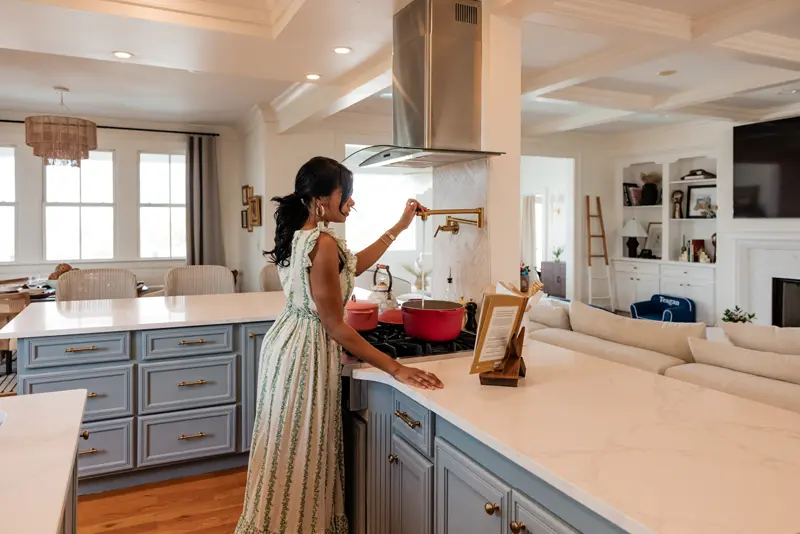
Pinckney Rutherford learned that recipes were passed down orally because formerly enslaved people could not write things down. She refuses for these culinary traditions to die with her generation, so dining spaces in the home are intentionally big, and seating areas and lounging spots throughout are meant to be comfortable. And she began hosting Thanksgiving and Juneteenth celebrations here, in this house, on James Island.
“I really hope to one day become the matriarch in our family,” she says. “Now that I have the opportunity to bring people together, I feel like I’m on that path of becoming the woman that I hope to one day be.”
Strong women and strong traditions have raised Pinckney Rutherford into someone who knows where she is from and where she is going. So much so that she has started a Future Matriarch Movement through her social media channels and e-newsletter. From writing prompts and personal reflections to heirloom product recommendations, each week Pinckney Rutherford shares actionable steps for women who want to take on the matriarch role.
In both her home on James Island and homebase in Columbia, Pinckney Rutherford elegantly blends old and new, the serious and the whimsical. While this mixture may look effortless, it is a skill she cultivated while representing James Island in the Miss South Carolina USA pageant in 2012, which she won. She went on to place in the top five in the Miss USA pageant. “I love beauty, fashion, and style and I care about what’s going on in my community at large. I don’t think that those things have to be mutually exclusive,” she says.
The combination of beauty and substance has sparked a book deal for the entrepreneur. In the fall of 2027, a coffee table book, Grits + Grace, will debut. Inspired by a book penned by another Southerner, Reese Witherspoon, Pinckney Rutherford hopes to preserve recipes, share stories, and explore the relationships among African American, West African, and Gullah Geechee cultures. “I want to use my family to tell that story,” she says, “and I’m going to tell that story through beauty, through resilience, in a way that I just have never seen it told before.”
The story is evident in every corner of Pinckney Rutherford’s James Island house, a second home where history, traditions and culture are shaped and shared. It is a place to cook your family’s favorite dish, just the way grandma made it. It is a cozy spot to sit and appreciate the view. It is a sacred space to explore the past and prepare the future. It is a powerful matriarchal movement wrapped in “Shades of Pinck” and strands of sweetgrass.
It is her home away from home.
 Pink’s Picks
Get the most out of a LowCountry experience
Mommy and me time:
“Cannon Park. It’s this beautiful, park with all these big oak trees, historic columns, huge open space and a playground. I love it because I can sit under the trees while Teagan runs around.”
Date night:
“Vern’s or Chez Nous. We both love to be out with people, so we’re going to have a nice, quiet dinner and then we’re going to end up at a bar downtown on King Street.”
Me-time:
“Gibbes Museum of Art or the International African American Museum and then shopping on Lower King Street and at Gwynn’s of Mount Pleasant.”
Playing tourist:
“Casual Crabbing with Tia. She’s this really amazing local black woman who has built this crabbing empire. It’s just so fun to actually go crabbing then take the live crabs to the Charleston Crab House on James Island Island. They will cook the crabs and then we eat them right there on the water.”